
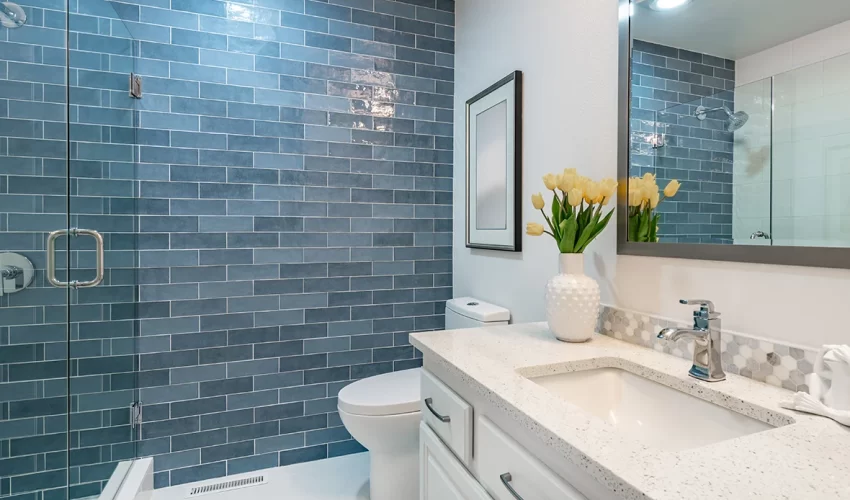
You know what I hear all the time? “My bathroom’s too small to do anything with.”
And look, I get it. You’re standing in a 5×8 bathroom that was built in 1975, and you’re trying to figure out how to make it work without knocking down walls or spending a fortune. The toilet’s practically touching the vanity. The shower’s so cramped you bang your elbows every time you wash your hair. And there’s nowhere to put anything.
But here’s the thing I’ve learned after doing maybe 200 bathroom remodels in Rockville, Bethesda, and all over Montgomery County. Small bathrooms aren’t hopeless. They just need smarter layouts.
I’m not going to lie to you and say we can make your 40-square-foot bathroom feel like a spa. But I can absolutely make it work better and feel bigger than it does right now. I’ve done it so many times I’ve lost count.
Let me show you how.
Your Bathroom’s Probably One of These Sizes
Most small bathrooms in Rockville and Bethesda homes fall into pretty predictable dimensions. The builders back in the day worked with standard sizes, which actually makes our job easier because we know what works.
The 5×8 bathroom is super common. That’s 40 square feet, and it’s usually a powder room or a full bath that’s been squeezed into whatever space was left over. You see these all the time in colonial homes and townhouses.
Then there’s the 6×9, which gives you 54 square feet. This was the standard full bathroom in houses built from the ’60s through the ’90s. Just barely enough room for a tub, toilet, and vanity, but not much else.
The 7×9 is what you find in a lot of colonial-style homes. At 63 square feet, it’s a little more generous but still feels tight by today’s standards.
And the 5×10 narrow bathroom—that’s the one that feels like a hallway. Fifty square feet, but it’s so narrow you can barely turn around.
Each of these sizes has its own quirks and challenges. But they also have solutions that actually work.
The Layout That Works Almost Everywhere
The three-wall setup is probably the most common layout for small bathrooms, and there’s a reason for that. It just makes sense.
You put your toilet on one short wall, your vanity on the opposite short wall, and your shower or tub-shower combo on the long wall. The door usually comes in from one end. Everything’s accessible, nothing blocks anything else, and you get as much open floor space in the middle as possible.
I did a bathroom last year in a Rockville colonial—classic 5×8 dimensions. The old layout had everything crammed together with barely 18 inches between fixtures. We stuck with the three-wall configuration but moved things around just slightly, and suddenly the bathroom felt way more spacious. The homeowner kept asking if we’d somehow made the room bigger.
Here’s a trick that helps: switch to a pocket door or make your door swing outward instead of into the bathroom. You’d be amazed how much space an inward-swinging door wastes. That’s space you could use for a bigger vanity or just for moving around without feeling claustrophobic.
For the vanity, go with 30 or 36 inches wide instead of the standard 24. Use a wall-mounted faucet to maximize counter space. If it’s a powder room where you don’t need storage, a pedestal sink opens up a ton of floor space.
Neo-angle showers in the corner work great too. They don’t feel as boxy as a standard square shower, and they save a few inches that makes a real difference in a small room.
When You’ve Got a Narrow Bathroom
The galley layout is what you want when your bathroom’s shaped like a hallway. I see these all the time in older Silver Spring and Wheaton homes.
You line up your fixtures along both long walls, leaving a clear path down the middle. Vanity and toilet on one side, shower or tub on the other. It’s basically a galley kitchen but for your bathroom.
The key is keeping that center pathway clear. You need at least 30 inches, preferably 36, for walking space. Any less and you’re squeezing sideways every time you go to the sink.
Use a shallower vanity—24 inches deep instead of the standard 30. That extra six inches in a narrow bathroom makes all the difference. Put in a sliding shower door instead of one that swings out. Add tall, narrow storage cabinets that go up instead of out.
I did one of these in Germantown last fall. The bathroom was 5×10, and the old layout had this massive vanity that made the whole space feel like a cave. We switched to a 24-inch-deep vanity, put in a sliding shower door, and added a floor-to-ceiling cabinet at one end. Same square footage, but it felt twice as big.
The Corner Shower Solution
If you’ve got a 6×9 bathroom and you’re trying to fit everything in without it feeling cramped, putting the shower in the corner is your friend.
This layout tucks a corner shower (usually 36×36 or a neo-angle) into one corner, puts the toilet next to it, and gives you the entire opposite wall for a nice long vanity. You can even fit double sinks if you want, which is great for shared bathrooms.
The big advantage here is that long vanity wall. When you’re not sacrificing wall space for a tub, you can go 60 or even 72 inches with your vanity. That’s huge for storage and counter space.
Use a clear glass shower door to keep sight lines open. Mount the vanity on the wall instead of having it sit on the floor—you’d be shocked how much more spacious that makes the room feel. And if you add a recessed niche in the shower instead of one of those awful corner caddies, you’re not eating up space with shower storage.
I just finished one of these in Bethesda. The couple wanted double sinks but thought their bathroom was too small. We did a corner shower, got them a 66-inch double vanity, and they were thrilled. Sometimes it’s just about using the space smarter.
When You Want to Get Fancy
Wet rooms are becoming really popular, especially in Bethesda and Potomac where people are going for that European spa vibe.
Basically, you make the entire bathroom waterproof and put the shower right in the open with no curb, no door, nothing. Just a drain in the floor and maybe a glass panel to keep water from spraying everywhere.
The whole room feels way more open because you’re not boxing off the shower. You’ve got this seamless floor that goes from one end to the other. It’s pretty dramatic.
But—and this is important—wet rooms need serious waterproofing. I’m talking waterproof membrane under the tile, proper sloping to the drain, excellent ventilation. This isn’t a DIY situation. If the waterproofing isn’t perfect, you’ll have water damage in the walls and floor, and that’s a nightmare to fix.
They cost more to build than a regular bathroom. You need a really good tile installer who knows what they’re doing with the slope. And you’ve got to be okay with the whole bathroom potentially getting a little wet.
But if you do it right? They’re amazing. Had a client in Potomac who converted their 7×9 master bath into a wet room, and it completely transformed the space. She texts me pictures of it every few months because she’s still that happy with it.
Ditching the Tub Entirely
Here’s a controversial opinion: most adults don’t take baths.
I know there are exceptions. Some people love baths. Kids need baths. But if you’re being honest, when was the last time you actually used your tub? For most people, it’s been converted into a shelf for shampoo bottles and razor collections.
That 60-inch tub is taking up a huge amount of space in your small bathroom. Space you could use for a really nice walk-in shower with actual elbow room.
I had a client in Olney who was adamant she needed to keep her tub. We worked around it, did the whole remodel, and it looked nice. Six months later she called me back. “I want to rip out the tub and put in a shower. I haven’t used it once.” We did the swap, and she kicks herself for not doing it from the start.
With that tub gone, you can put in a 48×36 shower, maybe bigger. Add a bench seat. Get a rain showerhead and a handheld. Include multiple niches for storage. Suddenly your cramped bathroom feels luxurious instead of cramped.
Just keep one tub somewhere in the house if you’ve got kids or you’re worried about resale. But in a secondary bathroom? Losing the tub usually makes way more sense.
Making It Work for Multiple People
If you’ve got a bathroom that gets used by multiple people—kids sharing a hall bath, that kind of thing—you need to think about privacy and function differently.
The divided space layout puts the toilet in its own little room or behind a privacy wall. The shower’s in its own zone. And the vanity’s out in the open where it’s accessible.
This means one person can be using the toilet while another person’s brushing their teeth. Game changer for families with teenagers who all need to get ready at the same time.
You need at least 6×9 to make this work, and honestly, bigger is better. The toilet compartment needs to be at least 36 inches wide to not feel like a phone booth.
I did one of these in a Darnestown house last year. Three kids, one bathroom, chaos every morning. We put the toilet in its own 3×5 alcove with a pocket door, kept the shower separate, and put in a 60-inch double vanity. The parents said it cut their morning routine stress in half.
Use a pocket door for the toilet room to save space. Make sure there’s a window or at least a good fan in there—nothing’s worse than a closed-off toilet room with no ventilation. And keep the flooring the same throughout to make the whole bathroom feel cohesive even though it’s divided up.
The Tricks That Work in Any Layout
Some things make every small bathroom better, no matter what layout you’re using.
Lighting’s huge. Most small bathrooms have one sad overhead light that makes everyone look terrible. Layer your lighting instead. Recessed ceiling lights, sconces by the mirror, maybe an LED mirror that has lighting built in. Good lighting makes a small space feel bigger and more expensive.
Go light with your colors. I’m not saying everything has to be white, but dark colors in a small bathroom make it feel like a cave. Light grays, soft beiges, whites—they reflect light and make the space feel more open. Save the dark dramatic colors for bigger rooms.
Big tiles are your friend. Small tiles mean more grout lines, and grout lines break up the visual space. Large-format tiles—like 12×24 or even bigger—create this seamless look that makes the room feel larger. Use them on the floor and the walls.
Frameless or semi-frameless glass shower doors. Those chunky metal frames block your sight lines and make the bathroom feel chopped up. Clear glass with minimal framing keeps the space feeling open.
Storage that doesn’t stick out. Recessed medicine cabinets instead of the kind that juts out from the wall. Floating vanities that expose the floor underneath. Built-in niches in the shower. Corner shelves in dead spaces.
What Montgomery County Codes Say
You can’t just do whatever you want. Montgomery County has requirements for bathrooms, and they’re there for safety and function.
You need at least 21 inches of clear space in front of your toilet, sink, and shower. The toilet needs to be at least 15 inches from its centerline to any wall or fixture. You need 24 inches of clear floor space in front of the shower entry.
If there’s no window, you’ve got to have an exhaust fan—minimum 50 CFM for bathrooms under 100 square feet. And it should really tie into a humidity sensor so it kicks on automatically when the shower gets steamy.
All your outlets need to be GFCI protected within six feet of water. If you’re doing any plumbing work, that goes through WSSC regardless of whether you’re in a city or unincorporated county.
Gaithersburg and Rockville have some city-specific stuff too, so working with a contractor who knows the local codes keeps you out of trouble.
Mistakes I See All the Time
People buy fixtures that are too big for their space. That beautiful freestanding tub you saw on Instagram? It’s not going to work in your 6×9 bathroom. It’ll overwhelm everything else.
Skimping on storage is another big one. Small bathrooms need smart storage more than big bathrooms do. If you don’t plan for it upfront, you end up with bottles and towels everywhere because there’s nowhere to put anything.
Door placement drives me crazy sometimes. I’ll see a bathroom where the door swings in and immediately hits the toilet or blocks the vanity. Just flip the door swing or use a pocket door. It’s not complicated.
Not using vertical space. When you don’t have floor space, go up. Tall cabinets, wall-mounted storage, floor-to-ceiling tile—all of it draws the eye upward and makes the room feel taller and more spacious.
Dark colors and busy patterns. A small bathroom covered in dark tile with a loud pattern feels even smaller. Keep it light and simple, then add personality with accessories you can change out.
What Works in Different Types of Houses
Colonial homes in Rockville usually have bathrooms tucked between bedrooms with standard 5×8 or 7×9 dimensions. The three-wall layout or corner shower setup works great in these.
Split-level homes—super common in Silver Spring—tend to have those narrow galley bathrooms or divided space layouts. Work with the narrowness instead of fighting it.
Townhouses in Gaithersburg often have small bathrooms stacked vertically to save space. Tub-free layouts or corner showers maximize the limited footprint.
Newer construction in Bethesda and Potomac might have slightly bigger bathrooms where you can get creative with wet rooms or spa-style designs.
Let’s Talk About Your Bathroom
Every bathroom’s different because every house is different and every family uses their bathroom differently. The retired couple in Chevy Chase who wants a spa-like retreat needs totally different things than the family with four kids in Germantown who just needs everyone to get out the door on time.
Your bathroom should work for how you actually live. Not what looks good in a magazine or what your neighbor just did.
We’ve done enough bathrooms in Montgomery County that we’ve seen pretty much every scenario. We know what works in these older homes, what the permit process looks like, and how to maximize space without making it feel like you’re working with smoke and mirrors.
And we’re not going to try to sell you on stuff you don’t need. If keeping your existing layout makes the most sense, I’ll tell you that. If going wild with a wet room is worth it, I’ll tell you that too.
Give us a call at 240-449-5164. Let’s look at your bathroom and figure out what’ll actually work in your space.